





Chilean firefighters develop a platform that gets crews to fires more efficiently.
The technology is used in Chile and in countries such as Argentina, Peru and Ecuador:
By Alexis Ibarra O.
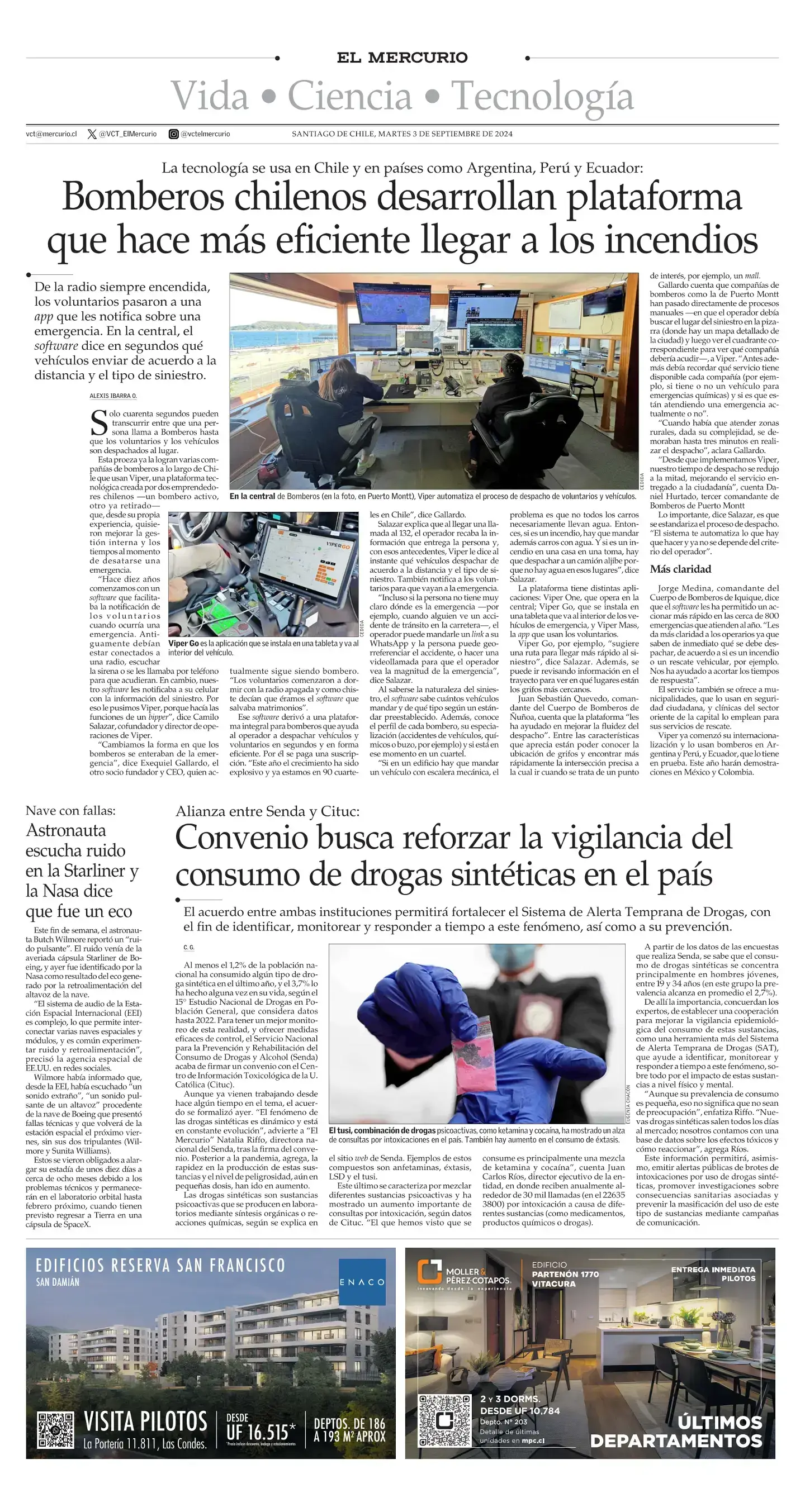 As little as forty seconds can pass between the moment someone calls the fire department and the moment volunteers and vehicles are dispatched to the scene.
Several fire companies across Chile already achieve this feat using VIPER, a technology platform created by two Chilean entrepreneurs (one an active firefighter, the other now retired) who, based on their own experience, wanted to improve internal management and response times when an emergency breaks out.
“Ten years ago we started with software that made it easier to notify volunteers when an emergency occurred. In the past they had to be tuned in to a radio, listen for a siren or be called by phone to respond. Our software, instead, notified them on their mobile phone with the details of the incident. That is why we called it VIPER, because it did the job of a beeper,” says Camilo Salazar, co-founder and COO of VIPER.
“We changed the way firefighters found out about emergencies,” says Exequiel Gallardo, the other partner and CEO, who is still a firefighter. “Volunteers started sleeping with the radio off, and they used to joke that we were the software that saved marriages.”
That software evolved into a comprehensive platform for fire departments that helps dispatchers send vehicles and volunteers in seconds and efficiently. It is paid for by subscription. “This year growth has been explosive, and we are already in 90 dispatch centers in Chile,” says Gallardo.
Salazar explains that when a call comes in to 132, the dispatcher gathers the information provided by the caller and, with those details, VIPER instantly tells them which vehicles to dispatch based on distance and the type of incident. It also notifies volunteers so they can respond to the emergency.
“Even if the person isn’t sure exactly where the emergency is (for example, when someone sees a traffic accident on the highway), the dispatcher can send them a link on WhatsApp so they can geolocate the accident, or start a video call so the dispatcher can see how serious the emergency is,” says Salazar.
Once it knows the nature of the incident, the software knows how many vehicles to send and of what type, according to a predefined standard. It also knows each firefighter’s profile, their specialization (vehicle accidents or hazardous materials, for example) and whether they are at the station at that moment.
“If you need to send an aerial ladder truck to a building, the problem is that not every engine necessarily carries water. So if it’s a fire, you also have to send engines with water. And if it’s a house fire in an informal settlement, you have to dispatch a water tender, because there is no water supply in those places,” says Salazar.
The platform has several applications: VIPER ONE, which runs at the dispatch center; VIPER GO, installed on a tablet inside emergency vehicles; and VIPER App, the app used by volunteers.
VIPER GO, for example, “suggests a route to reach the incident faster,” says Salazar. Crews can also check information on the way, such as where the nearest hydrants are.
Juan Sebastián Quevedo, commander of the Ñuñoa Fire Department, says the platform “has helped them improve the flow of dispatch.” Among the features he values are knowing where hydrants are located and quickly finding the exact intersection to go to when the call is about a point of interest, such as a shopping mall.
Gallardo says fire companies such as Puerto Montt’s have gone straight from manual processes (where the dispatcher had to find the incident location on a board with a detailed map of the city and then check the corresponding grid square to see which company should respond) to VIPER. “Before, they also had to remember which services each company had available (for example, whether or not it had a hazmat vehicle) and whether it was currently handling an emergency.”
“When they had to cover rural areas, given how complex they are, dispatch could take up to three minutes,” Gallardo explains.
“Since we implemented VIPER, our dispatch time has been cut in half, improving the service we provide to the public,” says Daniel Hurtado, third commander of the Puerto Montt Fire Department.
What matters, says Salazar, is that the dispatch process is standardized. “The system automates what needs to be done, and it no longer depends on the dispatcher’s judgment.”
More clarity
Jorge Medina, commander of the Iquique Fire Department, says the software has allowed them to act faster on the roughly 800 emergencies they handle each year. “It gives dispatchers more clarity, because they know immediately what to send depending on whether it’s a fire or a vehicle rescue, for example. It has helped us shorten response times.”
The service is also offered to municipalities, which use it for public safety, and clinics in the eastern part of the capital use it for their rescue services.
VIPER has already begun expanding internationally and is used by firefighters in Argentina and Peru, as well as in Ecuador, where it is being piloted. This year they will hold demonstrations in Mexico and Colombia.
See the printed page (in Spanish):