





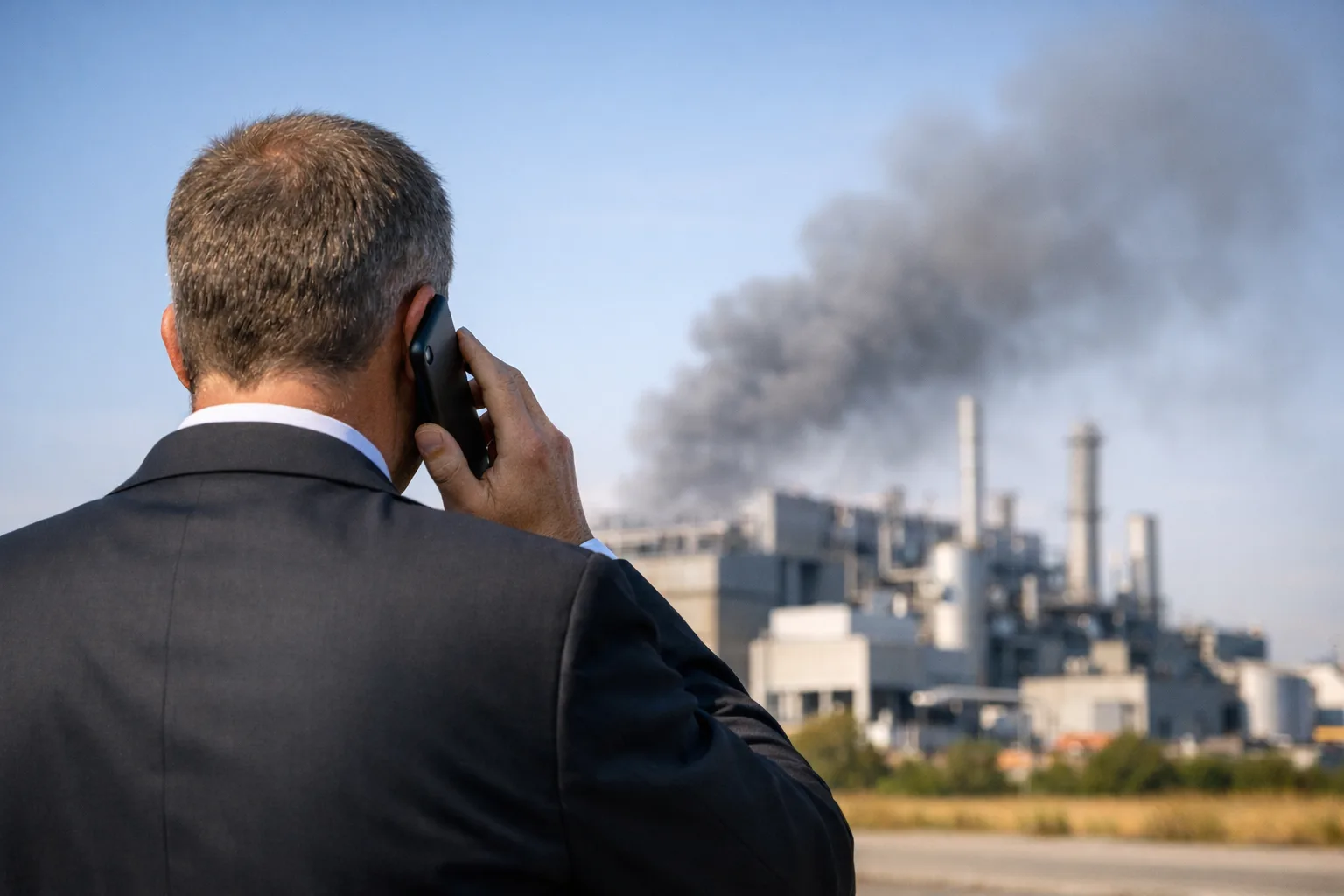
What organizations should know before it's too late.
At VIPER we have been working with emergency agencies, industrial companies and organizations that operate in high-risk environments for more than a decade. Along the way, we have learned a truth that, unfortunately, many organizations only discover when it is too late: the worst time to plan for a crisis is when the crisis has already occurred.
Chile is an exposed country. We know it. Seismicity, the energy industry, the transportation of hazardous materials and mining activity coexist with millions of people on a daily basis. And in that context, accidents—no matter how many measures are taken—can occur. What cannot be random is how an organization responds when that happens.
We want to reflect today, with all the sensitivity that the moment demands, on something that seems fundamental to us: the difference between managing an emergency well and managing the crisis that that emergency can trigger well.
An emergency is not a crisis. But it can become one.
There is a distinction that at VIPER we always make with our clients: an emergency is an event. A crisis is the loss of control of the narrative of that event. Both can occur at the same time, but they are different in nature and require different responses.
A well-managed emergency—with clear protocols, timely communication, team coordination, and real-time decision making—can be resolved without turning into a reputational crisis. But a poorly managed emergency, or even a well-managed but poorly communicated emergency, can morph into something that persists long beyond the event itself: a wound to the organization's public trust.
"The question is not just 'what do we do when something happens?' but 'what do we say, how do we say it and who says it?' "All that must be decided before."
The first hours define everything
In crisis management, there is what is known as the 'golden hour' of communication. It is not a metaphor: it is an operational reality. In the first hours after a critical event, society, the media, authorities and those affected observe the organization involved with a very specific question in mind: are they coming to terms with what happened?
Silence is interpreted as evasion. Generic statements read as coldness. The absence of a spokesperson with a human name and face feels like institutional cowardice. And all of this has reputational consequences that can last for years.
At VIPER we have worked with multiple organizations in the design of their emergency response protocols, and one of the elements we emphasize most is this: communication is not an area of support in a crisis. It's part of the operation.
The five most common mistakes that destroy reputation in a crisis
Based on case studies and our experience in the field, we identify the patterns that most frequently turn an accident into a long-term reputational crisis:
- 1 - Not having a pre-established crisis committee. Improvising the decision structure under pressure multiplies errors and response time.
- 2 - Let others tell your story first. If the Prosecutor's Office, the media or social networks build the narrative before the organization, recovering it is almost impossible.
- 3 - Communications without real empathy. Phrases like 'we regret the facts' without concrete actions behind them generate distrust. Audiences detect the difference between protocol condolence and genuine responsibility.
- 4 - Absence of human spokesperson. The institutions do not speak. People do. A trained spokesperson, with a name and face, is essential to convey credibility and empathy.
- 5 - Ignore the social context. In today's Chile, as in Latin America, a corporate crisis is not evaluated only on its own merits: it is evaluated in the context of distrust towards institutions. Organizations that don't understand this make mistakes that amplify the damage.
Technology and protocols: the two pillars of preparation
We believe that emergency preparedness has two inseparable dimensions: the technological and the human. It's no use having the best emergency management software if teams don't know how to use it under pressure. And the best protocols are of no use if there are no tools that allow them to be executed in real time.
Our platform allows organizations to centralize critical information during an emergency, coordinate geographically dispersed teams, issue mass alerts, and maintain a traceable record of every decision made. This record, in turn, is a fundamental asset in post-crisis management: it demonstrates that the organization acted diligently.
But technology alone is not enough. Real preparation also involves rehearsing scenarios, defining spokespersons, establishing communication channels with those affected and the media, and being clear about what can and cannot be said at the different stages of a crisis.
Each organization that works with VIPER has the ability to respond faster, with more information and with greater coordination. That does not eliminate the risk. But it radically changes how you deal with it.
Reputation is built before, not after
One of the most important concepts in reputational crisis management is 'trust capital'. Organizations that have built a history of transparency, responsibility and genuine care for people have a cushion that allows them to survive critical moments. Those that have not built it, no.
This has a direct implication for any organization operating in risky industries: reputation is not defended at the time of crisis. It is defended—or built—in the thousands of days prior to that crisis. In the protocols that are reviewed even if no one is looking. In the drills that are done even if they seem redundant. In the safety culture that is installed at each level of the organization.
At VIPER, we work precisely there: in those previous days. In the protocols, in the technology that makes them executable, in the preparation that makes teams capable of responding calmly when everything else is in chaos.
Our view as VIPER
We write this article with the awareness that behind every crisis we analyze there are real people, families affected, communities that suffer. We do not talk about these topics as an academic exercise. We mention them because we believe that the best way to honor those who have been affected by tragedies is to learn from them, and work so that they occur less often, or so that, when they do occur, organizations are on par with what people need.
Emergency management is not a niche service. It's a responsibility. And at VIPER we assume that responsibility as a reason for being.
Is your organization prepared?
Let's talk before you need it. → contacto@viper.cl
VIPER · Technological Solutions for Emergencies · Santiago, Chile · www.viper.cl